
Advanced vertical-axis wind turbine systems for autonomous infrastructure and hybrid energy solutions.
A counter-rotating vertical-axis wind turbine system engineered for multidirectional wind, reduced mechanical stress, and real-world deployment.
Most vertical-axis wind turbines have faced the same engineering limits for decades: vibration, unstable torque, poor performance in turbulent wind, and limited durability under real field conditions.
Unbalanced forces increase fatigue and shorten system life.
Irregular torque reduces efficiency and creates mechanical stress.
Real-world wind rarely behaves like laboratory airflow.
Complex mechanical systems often fail before the business case works.
WRTB was developed from a different physical principle. First discovered in 1994 by electrophysics engineer Sergey Bolotov and academician Albert Bolotov, the technology uses paired counter-rotating rotors to reduce reaction torque, eliminate the need for yaw alignment, and improve stability in multidirectional wind.
Instead of forcing the machine to fight turbulent wind, the system is designed to balance internal forces and convert chaotic airflow into smoother mechanical rotation.
The turbine does not need to turn toward the wind. It accepts wind from any direction, which reduces mechanical complexity.
Counter-rotation helps balance reaction forces, reducing the structural loads that commonly damage small wind systems.
Designed for real-world wind conditions where airflow is inconsistent, gusty, and multidirectional.
A more balanced rotor system supports smoother mechanical energy transfer into the generator.
The rotor system is integrated with a dynamic MPPT-based turbine-generator-controller architecture, designed to track optimal power output in rapidly changing wind conditions.
Instead of treating aerodynamics, generation, and control as separate layers, WRTB operates as a unified system - continuously adjusting to real-world wind behavior.
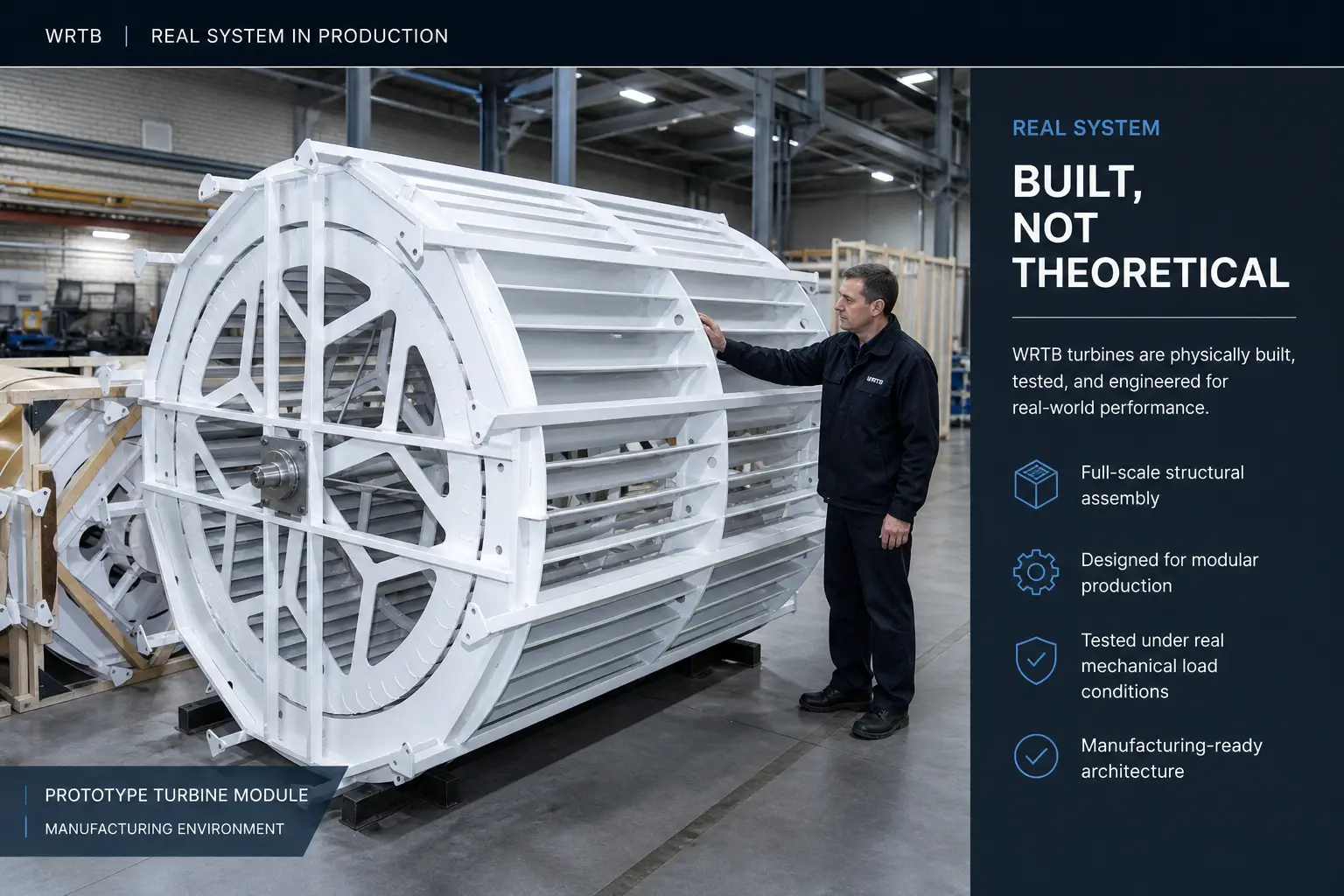
WRTB is not a conceptual design. Physical prototypes have been developed, manufactured, and tested in controlled and real-world environments.
The structure is designed for mechanical stability, reduced stress, and compatibility with scalable production methods.
WRTB prototypes have been tested in controlled environments and under real-world mechanical conditions to evaluate structural stability and system behavior in turbulent wind.
Early results indicate improved stability and more consistent power behavior compared to conventional small vertical-axis turbine designs.
WRTB technology is designed for environments where conventional small wind systems often struggle: telecom towers, off-grid infrastructure, coastal zones, industrial sites, and distributed energy networks.