WindRotor Bolotov
Advanced vertical-axis wind turbine systems for autonomous infrastructure and hybrid energy solutions.
Advanced vertical-axis wind turbine systems for autonomous infrastructure and hybrid energy solutions.
The WRTB (Vertical Rotor Turbine Bolotov) system is developed as a structural energy solution for remote and difficult-access communication infrastructure.
Unlike conventional wind generators, the system is designed to operate in turbulent wind conditions, integrate with tower structures, and support long-term autonomous operation with reduced maintenance dependency.
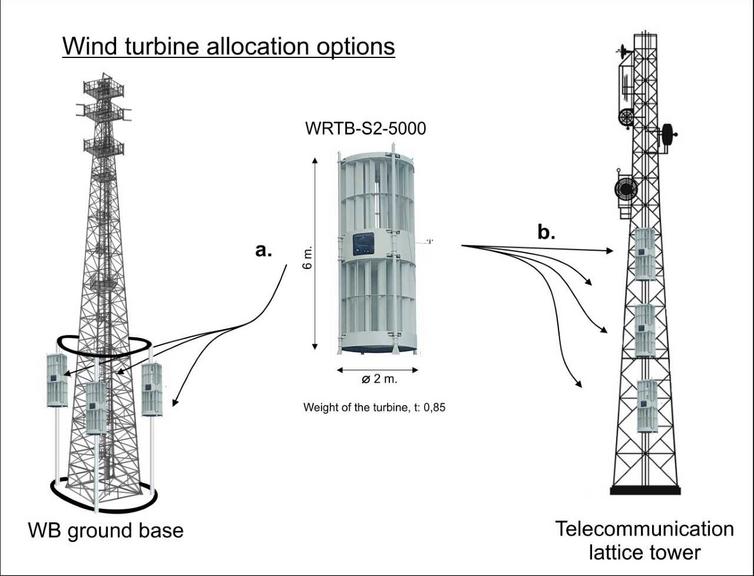
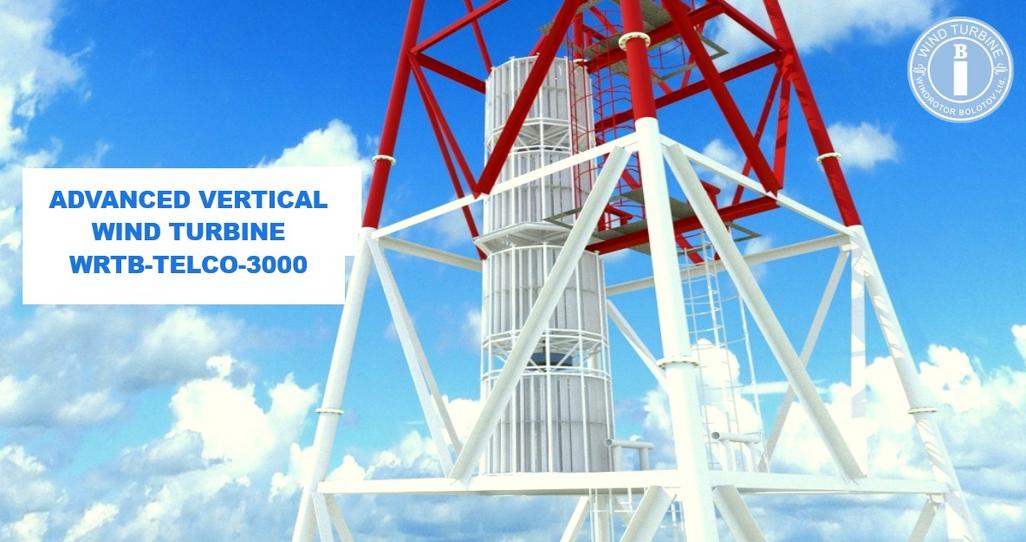
The WRTB system is not based on the assumptions used in conventional horizontal-axis wind turbines.
It is designed to operate in turbulent, unstable, and multidirectional wind environments typically found around structures such as communication towers.
Traditional wind turbines rely on steady, directional airflow and require orientation mechanisms to maintain efficiency. In real telecom installations, such conditions are rarely present due to terrain, obstacles, and structural interference.
The WRTB vertical-axis configuration allows the system to capture energy regardless of wind direction, eliminating the need for continuous repositioning and reducing mechanical complexity.
This simplifies operation and makes the system more suitable for long-term deployment in locations where access is limited and maintenance must be minimized.
In this context, the turbine is not treated as a separate device placed near the tower, but as part of a broader structural and operational concept.
The WRTB concept considers the communication tower not only as a support structure, but as part of the energy system itself.
Instead of placing a separate power unit nearby, the energy generation system can be integrated into the structural and functional logic of the tower.
This approach changes the overall architecture of the site. Energy generation, structural support, and communication infrastructure are treated as interconnected components rather than independent systems.
Such integration reduces the number of external elements, simplifies installation in remote locations, and improves overall system stability under real operating conditions.
In this configuration, the tower evolves from a passive structure with attached equipment into an active energy-supporting system capable of sustaining its own operation.
This is the basis for a more autonomous infrastructure model, where dependence on external power supply and continuous servicing is significantly reduced.
In remote telecom applications, reliability is achieved not by a single energy source, but by combining multiple systems into one coordinated operational structure.
The WRTB system is intended to operate as part of a hybrid energy configuration, where wind generation, storage, and auxiliary sources work together to maintain stable power supply under changing conditions.
Wind conditions around tower structures are not constant. Output varies over time due to turbulence, weather, and environmental factors. This variability must be managed at the system level rather than at the level of a single device.
Battery systems are used to accumulate generated energy and compensate for fluctuations. This allows the communication equipment to operate continuously even when generation temporarily decreases.
Additional energy sources such as solar panels or backup generators can be incorporated into the same system, creating a layered structure where each component supports overall stability rather than operating independently.
Control systems coordinate the interaction between generation, storage, and consumption, ensuring that available energy is distributed efficiently and that the communication infrastructure remains operational under all expected conditions.